
TREASURY’S NEXT CHAPTER: POWERED BY CROSS-GENERATIONAL TALENT

ISO 20022 Migration Hub

Understanding ISO 20022

What the standard is, why it matters, and the benefits it delivers

Migration Timeline & Key Dates

All critical deadlines, transition windows, and upcoming obligations

What You Need to Do - and When

Address requirements by payment type, deadlines by channel, and migration approach

LATEST NEWSLETTERS

What Is ISO 20022?

ISO 20022 is the new global standard for financial messaging, replacing the legacy SWIFT MT format for all interbank cross-border and high-value payments and associated cash reporting. It uses XML-based messages (referred to as MX) which can carry richer, more structured, and more granular payment data than was possible with fixed-length MT messages.

The migration - driven jointly by the financial industry and SWIFT - ran from March 2023 to November 2025, at which point all financial institutions completed the transition to ISO 20022 XML for cross-border payments. Most major domestic market infrastructures (RTGS and CSM) completed their own (big-bang) migrations before or during this period.


As of 22 November 2025: All financial institutions have successfully transitioned from SWIFT MT messages to ISO 20022 XML for all cross-border payments. BNP Paribas completed all migration milestones as a frontrunner institution.


THE CORE CHANGE

Instead of processing payment messages through FIN MT messaging (with its rigid, character-limited fields), banks and market infrastructures now use ISO 20022's data-rich XML standard. This standard can carry substantially more payment information in a structured and machine-readable format.


Comparison Table: Legacy MT vs ISO 20022 XML

Comparison Table: Legacy MT vs ISO 20022 XML


Business Benefits

The richer, structured, and granular data delivered by ISO 20022 XML messages unlocks significant operational and compliance improvements across the entire payment lifecycle.


AUTOMATION & EFFICIENCY

Enriched data sets promote end-to-end automation through the transaction lifecycle and increase machine-readability - enabling faster processing and straight-through processing (STP).

COMPLIANCE & FINANCIAL CRIME

Structured data leads to fewer false-positive hits in sanctions/compliance screening and more efficient AML/CTF monitoring - reducing delays and investigations.

INTEROPERABILITY

High-value and real-time payment systems converge on a common financial language, enabling frictionless cross-border (instant) payments with aligned formats across market infrastructures.

RECONCILIATION & REPORTING

Improved data quality supports reconciliation processes, centralised accounts payable and receivable, and treasury centralisation - enabling more accurate forecasting and faster treasury decisions.


PAYMENT TYPES COVERED

  • Cross-border and RTGS payments: Fully migrated. All interbank messages now use ISO 20022 XML (version 2019) - including TARGET2, EURO1, CHIPS (US), Fedwire (US), and CHAPS (UK).

  • SEPA Credit Transfers (SCT) and SEPA Direct Debits (SDD): From March 2024, interbank SEPA flows moved to ISO 20022 XML version 2019.

  • Cash Reporting: MT94x messages have equivalent ISO 20022 CAMT messages providing richer, structured account reporting.


KEY MARKET INFRASTRUCTURE MIGRATIONS

KEY MARKET INFRASTRUCTURE MIGRATIONS


Impact on Corporates

No mandatory deadline for corporate format migration. There is no regulatory requirement for corporates to migrate their own systems to ISO 20022 XML. After November 2026, corporates can continue using the SWIFTNet FIN network and send payments in MT101 format - provided address requirements are met.


The ISO 20022 migration primarily concerns the interbank space. However, corporates are indirectly impacted through two evolving requirements:

  • Structured addresses: From 15 November 2026, all payment instructions must include counterparty addresses in a structured or semi-structured format. Fully unstructured addresses will be rejected.

  • Additional data fields: As markets evolve, richer data (purpose codes, LEIs, structured remittance) will increasingly be expected in payment instructions.

BNP Paribas strongly recommends that corporates migrate international payments to XML format as soon as possible, as it is the only format fully compatible with the requested customer data structuration. An early adoption strategy makes your treasury more future-proof.


Recommendation: Ask your ERP/TMS vendors what their plan is to support ISO 20022 XML (both sending PAIN files and receiving CAMT reporting). Then choose the migration timeline that fits your organisation.


Master Timeline

The following timeline covers the full global ISO 20022 migration journey, from the first market infrastructure migrations in March 2023 through to the remaining corporate obligations in 2026 - 2027.

Master Timeline


Address Format Deadlines

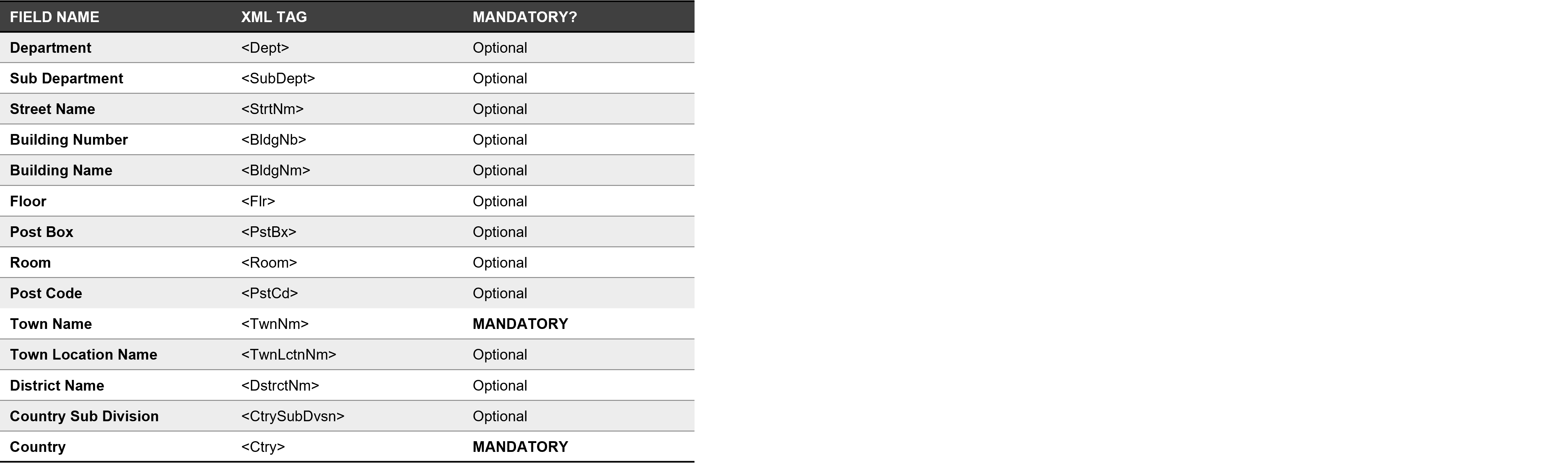
The table below summarises when each address format is accepted or rejected in payment messages. This is the most critical compliance area for corporates in 2026.

Address Format Deadlines


Action required: BNP Paribas will enforce address format validation from 15 November 2026 (payment execution date). Any payment missing Country Code or Town Name will be automatically rejected. Start reviewing and updating your counterparty address databases now.


CHAPS Enhanced Data (UK)

The Bank of England is leveraging ISO 20022's richer data capabilities to progressively mandate enhanced data for CHAPS payments. These requirements aim to improve payment efficiency, prioritise payments, and prevent financial crime.


FROM 1 MAY 2025 (IN FORCE)

  • Purpose Codes: Mandatory for CHAPS payments between financial institutions and for property transactions. Although optional for corporate clients, BNP Paribas recommends populating purpose codes for property payments. BNP Paribas has implemented this option in Connexis Cash for UK contracts.

  • Legal Entity Identifiers (LEIs): Mandatory for CHAPS payments between financial institutions. No direct impact on corporate clients.


FROM NOVEMBER 2026

  • Structured Addresses: CHAPS payments containing fully unstructured addresses will be rejected. Hybrid addresses (Town Name + Country as minimum structured fields) will be accepted.


FROM NOVEMBER 2027

  • Purpose Codes for all channels: Mandatory for all CHAPS payment types across all channels. We recommend assessing your ability to provide purpose codes ahead of this deadline.

  • Structured Remittance: Any remittance data must be structured, unless no appropriate structured remittance field exists for the specific data.


Corporate Action: Clients sending GBP CHAPS payments should assess the possibility of providing purpose codes by 2027 and ensure address structuring is in place before November 2026.


Address Requirements by Payment Type

The need to provide debtor and creditor addresses varies depending on the payment type and the countries involved. The rules below reflect current market requirements. BNP Paribas recommends systematically providing counterparty addresses in all payment instructions regardless of destination, to guarantee the most efficient processing.


Debtor Address Note: For Cross-border, RTGS, SCT and SCT Inst payments, BNP Paribas automatically retrieves and provides your debtor address from internal records - provided the debited account is held within the BNP Paribas Group. If BNP Paribas is your forwarding bank (you debit third-party bank accounts), you must include the debtor's structured address from 1 July 2026.


Address Requirements by Payment Type


EEA REFERENCE

  • EEA countries: EU 27 member states, plus Norway, Liechtenstein and Iceland.

  • SEPA non-EEA countries: Andorra, Monaco, San Marino, Switzerland, United Kingdom, plus small territories belonging to some SEPA countries.

  • EEA currencies (non-EUR): CHF, CZK, DKK, HUF, ISK, NOK, PLN, RON, SEK.

For a full list of countries with mandatory creditor address requirements, consult the BNP Paribas online Currency Guide (covering 130+ currencies) and the SWIFT PMPG Country Guidance on swift.com.

Deadlines by Channel

The table below summarises the action required by corporate clients for each channel and party address, along with the applicable BNP Paribas enforcement date.

Deadlines by Channel


Upcoming Connexis enforcement: From 9 May 2026, BNP Paribas will impose the TownName field for manual entries in Connexis Cash. Ensure all standing orders, recurring instructions, and future-dated transactions are updated in Connexis before 15 November 2026.


Recommended Migration Steps

Whether you plan to adopt ISO 20022 XML fully or simply comply with the address structuring requirements, the following steps will help ensure a smooth transition.

 

STEP 1 ASSESS YOUR CURRENT STATE
Action: Audit payment formats and address data.

Review your existing payment initiation formats (MT101, CFONB320, proprietary files, pain versions). Identify which channels, payment types, and counterparty addresses are impacted. Check your ERP/TMS vendor's ISO 20022 readiness roadmap.


STEP 2 CLEAN & STRUCTURE ADDRESS DATA
Action: Remediate counterparty address databases.

Review all counterparty addresses in your master data, ERP, treasury, and HR systems. Modify them to include at minimum a structured Country Code (ISO 2-letter) and Town Name. Reach out to counterparties missing this data as soon as possible.


STEP 3 COMPLY BY 1 JULY 2026 (THIRD-PARTY BANK SERVICE USERS)
Action: Ensure payment instructions for third-party bank accounts include the debtor's structured or semi-structured address by 1 July 2026 to avoid SWIFT rejection.


STEP 4 COMPLY BY 15 NOVEMBER 2026 (ALL CLIENTS)
Action: Enforce structured/hybrid addresses in all payment instructions.

All payment instructions - including standing orders, recurring transactions, and future-dated payments - must include addresses in structured or semi-structured format. Where compliance cannot be guaranteed, avoid initiating sensitive payments around this date. BNP Paribas will enforce address validation from this value date.


STEP 5 PLAN XML MIGRATION (RECOMMENDED)
Action: Migrate to pain.001 (v2019 recommended).

Although not mandatory, migrating to XML pain.001 is the only format fully compatible with current and future data structuration requirements. Coordinate with your ERP/TMS vendors and BNP Paribas. Message guidelines are available in MyStandards. Consider a big-bang approach (switch both payments and reporting at once) or a phased approach (CAMT reporting first, then PAIN payment initiation).


The End of the Beginning

EN: Read the Newsletter #1 2026 | FR:Read the Newsletter #1 2026


BNP Paribas is your partner throughout this transition. Your dedicated Cash Management Officer and our team of experts are available to guide you through every step. Contact your Cash Management Officer or visit www.cashmanagement.bnpparibas.com for further guidance including the online Currency Guide and country-specific address requirements.